1. What's Actually Happening on the Shelf
For years, high-fructose corn syrup (HFCS) was the default for industrial beverage and bubble tea formulations. It is cheap, highly miscible, and easy to pump, and in a price-driven market it does the job.
But buyers are asking different questions now. Brand owners and importers no longer ask only about price. They look at the first ingredient on the list, and more of them want to see white sugar (sucrose) there.
This article looks at what changes in the drink, in the prep room, and in the cost per cup when a compound fruit base is built on sucrose instead of HFCS. It is about our White Sugar Fruit Puree Series, a separate line from SariBoost.
2. Why Buyers Are Moving Away from HFCS
White sugar is the most widely understood sweetener in the category. "0% HFCS" or "sucrose-based" on a spec sheet separates a product from low-cost commodity syrups and makes the conversation with downstream buyers easier.
The sensory difference matters too. In high-acid fruit applications such as passion fruit or citrus, HFCS tends to give a sharp sweetness spike that fades quickly, leaving a thin, cloying finish. Sucrose gives a broader, rounder mouthfeel that sits well with the fruit's natural acidity and supports the top notes. Taste depends on the full recipe, but the difference is usually visible in side-by-side cup tests.
3. What a Sucrose-First Base Actually Contains
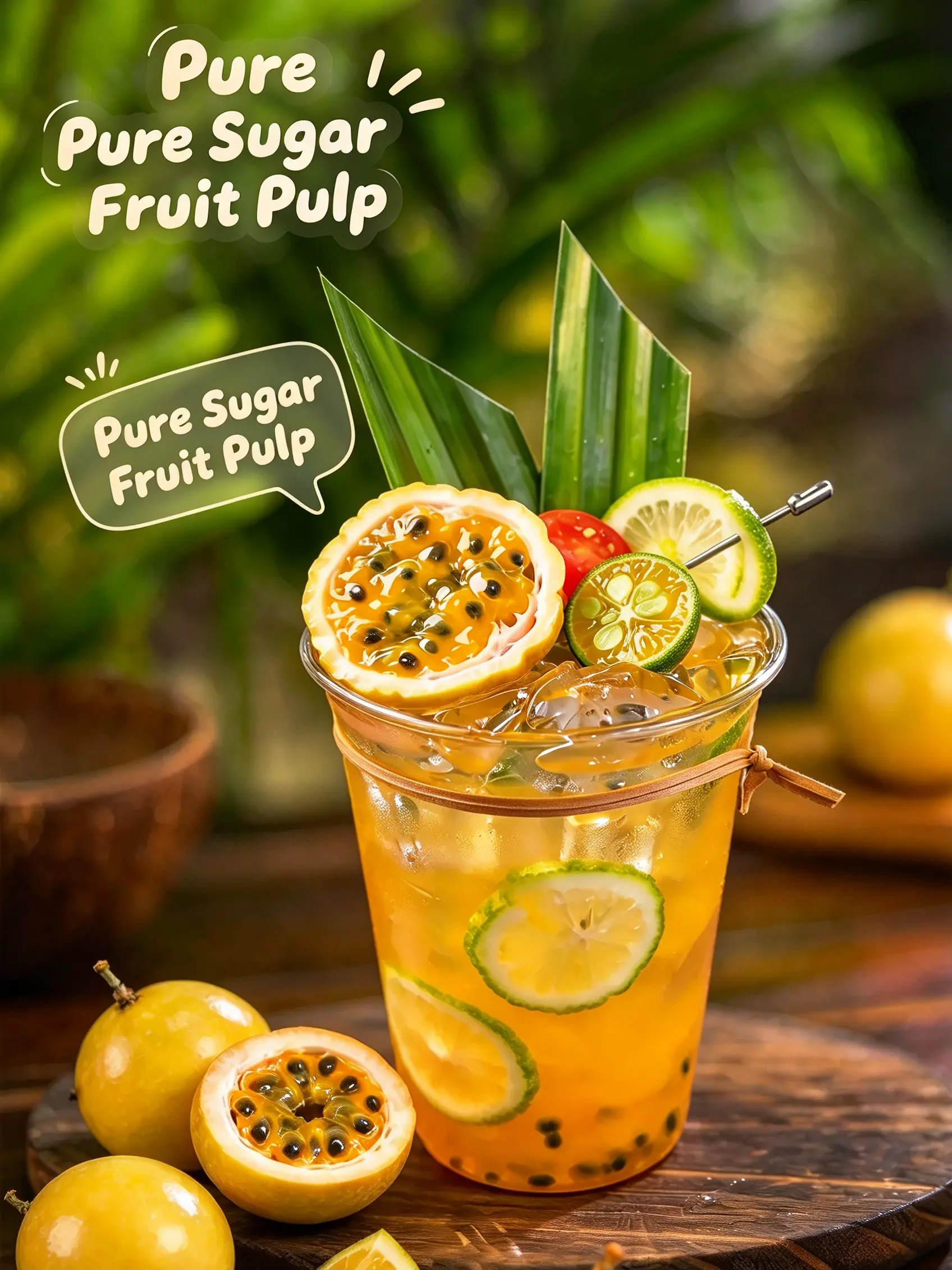
The series is built on real fruit puree, and we publish the full formula. Values in this article are for the Passion Fruit flavor unless stated otherwise.
Sucrose first, fruit puree second. Granulated white sugar gives the base its body. Every flavor in the series contains at least 30% real fruit puree, so the drink has real fruit character, not only sugar.
Juice and acid balance. Concentrated lemon juice and apple juice support the main puree, together with citric and DL-malic acids to keep the tartness crisp.
Sweetness system. The base is anchored with sugar, at 50.3 g of sugars per 100 g (per the Passion Fruit label), with small amounts of acesulfame potassium and sucralose to adjust sweetness intensity and dosing.
We publish the full ingredient list because buyers test the product anyway. Here is the Passion Fruit label, verbatim:
White granulated sugar, passion fruit puree (≥30%), water, lemon juice concentrate, apple juice concentrate, acesulfame potassium, sucralose, citric acid, DL-malic acid, potassium sorbate, vitamin C, xanthan gum, carrageenan, sodium carboxymethyl cellulose, and food flavouring.
4. One Series, Eight Flavors
The series comes in eight flavors: Sugar Green Grape, Sugar Black Grape, Sugar Passion Fruit, Sugar Mulberry, Sugar Red Guava, Sugar Kumquat Lemon, Sugar Red Grapefruit, and Sugar Honey Peach. All use a sucrose-first formulation and share the same ambient, 12-month shelf life.
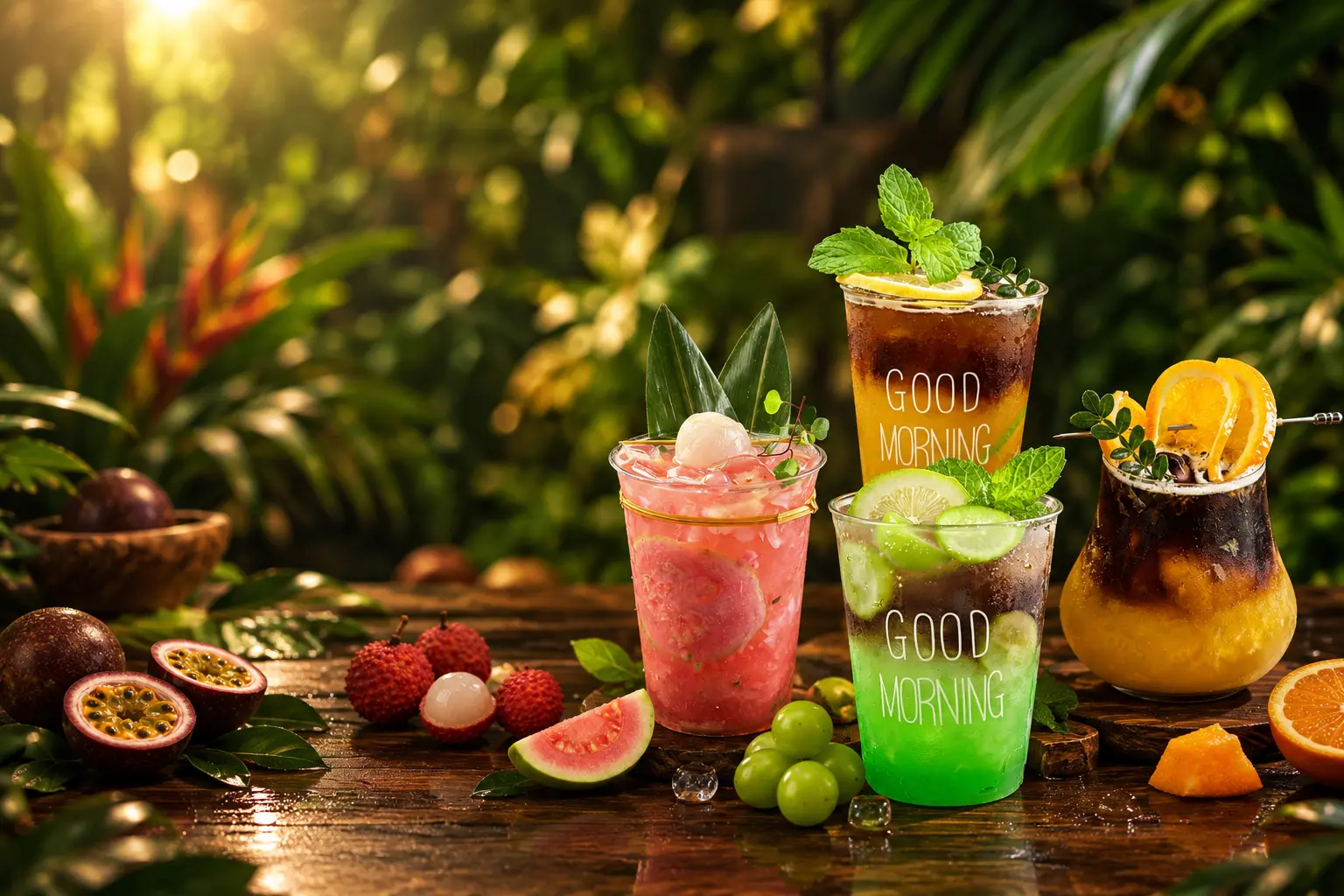
For importers in tropical markets, the effect is direct. Grape and peach are popular on menus but are not typical tropical crops, so bringing them in fresh or frozen means cold-chain shipping and storage at every step. That adds cost, handling risk, and waste.
A shelf-stable concentrate removes that constraint. The series ships and stores at ambient temperature, so a tropical-market chain can put grape or peach drinks on the menu without building a cold chain around them. Tropical flavors such as passion fruit and guava are part of the same series, so one supplier and one workflow cover the whole menu.
5. Barista Workflow and Cost-in-Use
The reference dosage is 45–50 g of concentrate per 500 ml of finished drink, roughly a 1:10 dilution. This reflects local taste preferences in our home market; adjust it to your own market. The right ratio varies by market, recipe, and target sweetness and acidity, so it should be set through your own testing.
Using the Passion Fruit label value (50.3 g of sugars per 100 g), that dosage brings about 22.6–25.2 g of sugar into a 500 ml cup, or roughly 4.5–5.0 g per 100 ml. Your R&D team can use these figures directly in menu nutrition models.
It also removes several prep-room steps. The acid, sweetness, and puree ratio are built into the concentrate, so staff weigh a fixed amount and mix it with tea or water. No sugar boiling, no fruit prep, no shift-to-shift acid adjustments.
6. Factory Capabilities: How Ambient Stability Is Built
Ambient stability depends on four things working together: high sugar content, an acid system, a preservative (potassium sorbate), and aseptic filling.
Water and cooling. Water is treated on the factory's own high-standard pure water line. A closed cooling system then brings the product from over 90°C to around 40°C in about 20 minutes, which helps protect the fruit's natural color and limits cooked flavor. The same cooling system is described in our article on batch consistency.
Keeping the puree suspended. High-puree products tend to separate during ocean freight. Purees do not stay suspended on their own, so a balanced blend of xanthan gum, carrageenan, and sodium carboxymethyl cellulose keeps the puree evenly dispersed from the warehouse to the end cup.
Shelf life. Unopened and stored in a cool, dry place, the series holds a 12-month ambient shelf life. No refrigerated containers are needed.
Every batch is tested and a retention sample is kept. Fruit varies naturally, so the COA (Certificate of Analysis) sent with your sample is specific to the batch the sample was taken from. Each shipment carries its own batch COA.
7. Testing It on Your Own Bench
How you test matters as much as what you test. A suggested sequence:
Start at the reference dosage. Use 45–50 g per 500 ml of finished drink as a starting point, not a fixed rule.
Test in your real drink. Use your own tea base, ice level, and serving size, since these change how sweetness and acidity are perceived.
Adjust to your market. Move the dosage up or down until sweetness and acidity fit your customers.
Recalculate sugar per cup. Once you settle on a dosage, use the label value for your flavor (50.3 g of sugars per 100 g for Passion Fruit) to update your nutrition figures.
Check suspension. Let a prepared sample stand and observe how evenly the puree stays dispersed.
Confirm local limits. Check the sweeteners and preservative against the additive rules of your target market before you commit.
8. Core Specifications
| Series Name | White Sugar Fruit Puree Series |
|---|---|
| Flavors | 8: Green Grape, Black Grape, Passion Fruit, Mulberry, Red Guava, Kumquat Lemon, Red Grapefruit, Honey Peach |
| Sweetener Base | 0% HFCS; white granulated sugar as the #1 ingredient |
| Fruit Content | ≥30% real fruit puree (all flavors) |
| Sugar Level | 50.3 g per 100 g (Passion Fruit, per product label) |
| Reference Dosage | 45–50 g per 500 ml finished drink (~1:10 dilution); adjustable to local taste |
| Typical Applications | Fruit tea, bubble tea, sparkling drinks, iced coffee drinks |
| Shelf Life | 12 months, unopened, ambient storage |
Sugar values shown are for Passion Fruit. The reference dosage is a starting point; confirm both per flavor with the TDS.
If you are an importer, distributor, or brand R&D director, request an R&D Sample Kit. Every sample ships with the Technical Data Sheet (TDS) and the COA for the sample batch, so you can test it on your own bench before placing an order.
Does 0% HFCS mean the series contains no sugar?
No. 0% HFCS means the sweetener base is white granulated sugar (sucrose) rather than high-fructose corn syrup. The Passion Fruit label shows 50.3 g of sugars per 100 g. Small amounts of acesulfame potassium and sucralose are also used to adjust sweetness intensity and dosing.
How do I calculate sugar per cup at my own dosage?
Take the label sugar value for your flavor (50.3 g per 100 g for Passion Fruit) and multiply by the grams of concentrate you use per serving. At the reference dosage of 45–50 g per 500 ml, that works out to about 22.6–25.2 g of sugar per 500 ml cup, or roughly 4.5–5.0 g per 100 ml.
Can I test the series before placing an order?
Yes. Request an R&D Sample Kit. Every sample ships with the TDS and the COA for the sample batch. Test it at the reference dosage in your own tea base, ice level and serving size, then adjust to your market before committing to a trial order.
- 01 · Earn More Develop a stronger cost proposition around the drink your customer wants to sell.
- 02 · Sell the Experience Turn a finished-drink application and a clear formulation story into a stronger sales offer.
- 03 · Own the Category Build fruit, tea and vegetable drink applications around the market you know.
- 04 · Win the Long Game Scale with an 18,000-tonne annual factory capacity behind your growth.